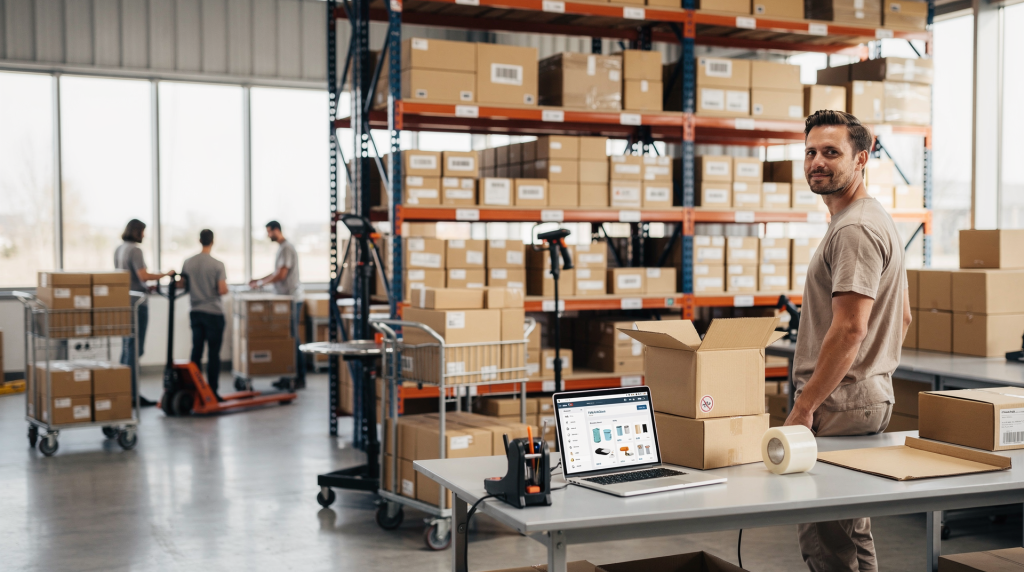
For most online stores, the shift to a dedicated warehouse doesn’t come from a single dramatic event. It creeps up quietly: fulfillment starts eating more hours than it should, mis-picks become a weekly headache, and inventory control feels like a game of Tetris you’re always losing. The right warehouse isn’t just extra square footage—it’s an operational asset that protects speed, accuracy, and your ability to scale without breaking the customer experience.
Why the move matters
A warehouse becomes necessary when spare bedrooms, garages, and rented storage units stop supporting the pace of the business. At that point, the question is no longer “where do we put things?” but “how do we keep shipping reliably without throttling growth?”
The main advantage of a dedicated warehouse is control. You gain a single, organized footprint where receiving, storage, packing, and shipping flow in sequence. That matters because ecommerce businesses often need more logistics space per dollar of revenue than traditional retail—returns, split shipments, and kitting all demand extra square footage. But capacity isn’t just about area; it’s about throughput, labor efficiency, and process flow. A well-designed 1,500-square-foot warehouse can easily outperform a cluttered 3,000-square-foot space if the layout respects how work actually moves.
From a lease perspective, this is also where you start thinking about things like dock-height vs. grade-level access, clear ceiling height for vertical racking, and whether the building’s zoning allows the type of activity you’re running. These aren’t abstract broker terms—they directly affect how many orders you can push out before the carrier cutoff.
The clearest signs you have outgrown home or shared storage
1. Packing is taking over your day
When fulfillment starts consuming hours that should go toward marketing, sourcing inventory, or product development, the business is sending a clear signal. If you’re the founder and you’re spending more time taping boxes than talking to customers or planning the next product launch, growth usually stalls.
A strong warning sign is when you’re consistently pushing cutoff times, printing labels in a panic, and packing orders late into the evening. That’s not sustainable. In a dedicated warehouse, packing becomes a defined station with the right tools, materials, and space—not a kitchen table operation that expands to fill every available minute.
2. Inventory is spreading into every available corner
Closets, hallways, guest rooms, and even the space under desks slowly turn into mini-warehouses. Once stock stops fitting into one organized area, picking gets slower and errors multiply. You lose the clean separation between living space and inventory, and that creates avoidable problems: damaged products from being stacked in odd places, misplaced cartons, poor stock visibility, and wasted time hunting for a single SKU.
A dedicated warehouse gives you back that separation. It also lets you implement basic racking and bin locations, which alone can cut pick times by 30–40% compared to searching through piles.
3. Order accuracy is slipping
When wrong items, missing items, or oversold products start appearing more often, the issue is rarely the team’s effort. It’s the environment. A home setup forces you to combine functions that should be physically apart: receiving happens where you pack, returns pile up next to outbound orders, and there’s no staging area that keeps “ready to ship” separate from “still needs checking.”
A proper warehouse layout reduces errors by giving every part of fulfillment a distinct zone: receiving, storage, packing, shipping staging, and returns. If you can’t maintain those boundaries in your current space, you’re already operating beyond the comfort zone of a home-based model—and your error rate will prove it.
4. You are missing shipping cutoffs
Missing carrier pickup windows is one of the most practical signs that your operation has outgrown its current footprint. It means your process is too slow, your staging area is too small, or your workflow is too scattered. Once shipping speed becomes inconsistent, customer expectations and review quality suffer—and in ecommerce, a late delivery often counts as a failed delivery in the customer’s mind.
A dedicated warehouse helps because it supports better flow, not just more storage. You can stage outgoing parcels near the dock, prep manifests without tripping over inbound cartons, and give carriers a clear handoff point. For brands doing last-mile delivery or using multiple carrier services, that physical clarity is non-negotiable.
5. Receiving new stock is becoming a problem
If inbound deliveries are awkward to unload, there’s nowhere to stage cartons for counting, or new inventory sits in piles for days before being put away, your operation needs a better physical structure. Receiving is one of the most overlooked parts of ecommerce logistics. Without a designated receiving zone, inventory gets mixed with outbound stock, which leads to confusion, inaccurate counts, and sometimes double-shipping.
In a warehouse, you can set up a proper receiving area with a dock or at least a ground-level roll-up door, a staging floor for inspection, and a direct path to put-away. That alone can cut the time from delivery to available inventory by half.
6. You are turning down growth
A very clear signal is when you hesitate to buy more inventory because there’s nowhere to store it. Another is when you pass on wholesale, seasonal, or bundle opportunities because fulfillment capacity is too fragile. If storage constraints are stopping sales, the business is no longer limited by demand—it’s limited by operations.
I’ve seen brands turn down a 40% margin wholesale order because they couldn’t physically receive the pallets. That’s not a sales problem; it’s a real estate problem. A warehouse removes that ceiling and lets you say yes to growth without first calculating whether your garage can handle it.
Practical thresholds that often point to warehouse readiness
There is no single order count that forces the move, but patterns emerge. Many smaller ecommerce sellers start feeling pressure once monthly order volume reaches a few hundred and the business is still growing. Industry guidance commonly places the shift somewhere around 200 to 500 orders per month, especially when inventory and packing work are already consuming most of the day.
A useful way to think about it is this:
| Signal | What it usually means |
|---|---|
| 100–300 orders per month | You may still manage from a compact setup, but only if SKU count is low and workflow is simple. |
| 300–700 orders per month | Dedicated packing and storage space becomes increasingly valuable. |
| 700+ orders per month | A warehouse is often needed to keep speed and accuracy stable. |
| Frequent seasonal spikes | You need buffer capacity, not just enough space for average demand. |
| Multiple staff members | Shared home setups usually break down once more than one person is packing regularly. |
These numbers are not rules. They’re warning zones. The real decision depends on SKU count, inventory depth, packaging size, return volume, and how much labor the business can support. A brand selling 200 large, bulky items a month may need a warehouse sooner than one shipping 500 small, lightweight parcels. Similarly, if you’re dealing with high return rates—common in apparel or electronics—the space needed for processing returns alone can tip the balance.
How to judge whether you need a warehouse now or just better organization
Before signing a lease, separate a real warehouse need from a temporary clutter problem. Sometimes the issue isn’t square footage; it’s that your current space has no workflow design. Investing in shelving, better bins, and a stricter put-away system might buy you another six months. But if the underlying constraints are structural—no room for a packing table, no staging area, no way to receive a pallet—then better organization won’t fix it.
Ask these questions
- Do we consistently run out of storage for current inventory?
- Are packing and shipping taking longer every month?
- Are we making more fulfillment mistakes than we can afford?
- Do we need a receiving area that does not interfere with outbound orders?
- Are seasonal peaks forcing us into crisis mode?
- Are we buying inventory cautiously because of space limits?
- Would a second person make the current setup worse instead of better?
If you answer yes to several of these, a dedicated warehouse is probably the right next step—and waiting too long will cost more in errors and missed sales than the rent ever will.
What a warehouse should actually solve
A warehouse is not just a bigger room. It should solve specific operational problems. If the space doesn’t improve workflow, it’s just expensive storage—and you’ll end up paying for square footage that doesn’t contribute to throughput.
A good warehouse gives you:
- Clear receiving space for inbound inventory, with room to inspect and count before put-away
- Organized shelving or racking for fast-moving and slow-moving SKUs, ideally with bin locations tied to your inventory system
- A dedicated packing area with enough room for materials, scales, and multiple pack stations if needed
- Shipping staging for outgoing parcels and carrier handoff, separate from inbound goods
- Returns processing space that doesn’t contaminate forward-pick areas
- Better control over inventory counts through cycle counting and physical separation
- Room to handle seasonal spikes without chaos—think temporary overflow racking or flexible staging zones
From a real estate standpoint, these functions translate into specific physical requirements: adequate column spacing for racking, sufficient electrical outlets for packing stations, and a layout that minimizes travel time between zones. When touring a space, mentally map these zones onto the floor plan. If you can’t see how the flow would work, the building is fighting your operation.
How much space do you need?
The right size depends on your inventory model, but many growing ecommerce sellers can start with a compact warehouse and scale from there. Practical guides commonly suggest that smaller operations may work in the range of 500 to 1,500 square feet, with the higher end becoming more realistic as SKU count, palletized storage, and team size increase.
A simple sizing approach looks like this:
- Estimate how much inventory you hold at peak (in cubic feet or pallet positions, not just units).
- Add space for packing, receiving, and shipping—typically 25–35% of your storage footprint.
- Add extra room for seasonal growth; a 20% buffer above peak is a safe starting point.
- Check whether your largest items and cartons can move safely through aisles and doorways.
- Make sure the layout supports your workflow, not just storage volume—don’t forget space for returns and supplies.
A common mistake is sizing for today’s inventory only. That usually means the space feels perfect on day one and too small six months later. Also, pay attention to clear height. If you can rack vertically, you might need less floor area, but that requires adequate ceiling height (at least 14–16 feet for basic pallet racking) and possibly a forklift or stacker. Leasing a space with 10-foot ceilings when you need to go up is a costly oversight.
Common mistakes when moving too early or too late
Moving too early
- Paying for space you don’t actually use, which adds fixed overhead before revenue can support it
- Taking on a lease with a term that locks you in beyond your growth horizon—three years might be too long if you’re still testing volume
- Underestimating setup costs for shelving, equipment, internet, security, and possibly a deposit on utilities
- Choosing a location that is convenient for you personally but inefficient for carriers or suppliers, increasing inbound shipping costs
- Not accounting for triple-net (NNN) charges—property taxes, insurance, and maintenance can add 20–30% to the base rent
Moving too late
- Letting order accuracy slip to the point where negative reviews start affecting conversion
- Creating damaged inventory through poor storage conditions—humidity, dust, or simply being crushed in a corner
- Wasting labor hours searching for stock, which erodes margin and delays shipments
- Missing shipping deadlines consistently, leading to carrier penalties or lost customer trust
- Blocking sales because there’s no room for new inventory, effectively capping your revenue
The best time to move is usually before the operation becomes visibly broken. Once customers notice delays and mistakes, the transition is already late—and you’ll be playing catch-up while trying to set up a new space.
Step-by-step checklist: are you warehouse-ready?
Use this checklist as a practical test. If five or more of these are true, it’s time to start looking seriously at dedicated warehouse options.
- Inventory no longer fits cleanly in your current space.
- Packing work is taking multiple hours a day.
- Shipping errors or mis-picks are increasing.
- You need a proper receiving area that doesn’t interfere with outbound orders.
- Seasonal demand creates chaos instead of manageable overflow.
- You are holding back purchases because of storage limits.
- A second person cannot work efficiently in the current setup.
- Your current space is affecting customer experience (late deliveries, damaged goods).
- You need better control over the full fulfillment process, from receiving to returns.
What to do before signing a lease
A warehouse decision should be based on operations, not just square footage. The cheapest rent can become the most expensive if the space slows down receiving, creates labor waste, or forces constant reorganization.
Review these factors
- Location relative to carriers, suppliers, and customers: Being close to a major carrier hub can cut last-mile delivery times and reduce shipping costs. Also check if the area is zoned for your type of activity—some light-industrial zones restrict retail or high-traffic ecommerce.
- Access for delivery vehicles: Can a 53-foot trailer get in and out? Is there a dock, or will you need a liftgate? Ground-level roll-up doors are fine for smaller operations, but if you’re receiving pallets regularly, a dock becomes important.
- Ceiling height and usable storage volume: Vertical space is cheap storage. Look for at least 14–16 feet clear if you plan to rack, and check for obstructions like low-hanging heaters or sprinklers.
- Dock or ground-level receiving: Even a single dock door can dramatically speed up unloading. If the space only has a man-door, factor in the cost of a portable ramp or lift.
- Power, internet, and climate control: Adequate power for packing stations, computers, and possibly conveyor or automation. Climate control matters if you store heat-sensitive products or electronics. Humidity can ruin packaging and inventory.
- Ability to add shelving, packing stations, and workflow zones: Check column spacing (wide bays are better), floor condition, and whether the landlord allows modifications like anchoring racking.
- Lease terms that fit your growth horizon: A two-year lease with an option to renew gives flexibility. Avoid long-term commitments unless you’re confident in your volume projections. Also clarify who pays for what in a triple-net lease—base rent is only part of the picture.
Walk the space with your fulfillment process in mind. If you can’t visualize the flow from receiving dock to shipping staging without backtracking, the layout will cost you time every single day.
FAQ
How do I know if my online store is too big for home storage?
If inventory is spreading across multiple rooms, packing takes too long, and errors are increasing, home storage is no longer supporting the business well. The breaking point often comes when you can’t separate living and working areas, or when a single large inbound shipment throws everything into disarray.
Is a 3PL better than a warehouse?
It depends on control, volume, and margin. A 3PL can work well if you want to outsource fulfillment entirely—they handle labor, space, and often carrier negotiations. But you lose direct oversight, and the per-order fees can eat into margins on lower-priced items. A dedicated warehouse makes more sense when you need direct control over inventory accuracy, custom packaging, or kitting, and when your volume justifies the fixed cost of a lease. Many brands start with a 3PL and transition to their own space once they hit a steady 500–700 orders per month and want to reduce variable costs.
What is the biggest sign I need a warehouse?
The clearest sign is when fulfillment starts limiting growth. If storage, packing, or shipping is stopping you from buying inventory or serving customers efficiently, the business has outgrown its current setup. That might show up as turning down orders, missing carrier cutoffs, or seeing your error rate climb despite your best efforts.
Can a small ecommerce brand benefit from a warehouse?
Yes, especially if the brand has bulky products, growing SKU counts, frequent restocks, or regular seasonal spikes. A small warehouse—even 500–800 square feet—can create structure before the operation becomes chaotic. It gives you a proper receiving area, organized storage, and a dedicated packing station, which often pays for itself through faster processing and fewer mistakes. Just make sure the lease terms are flexible enough to let you grow or exit without penalty.
Conclusion
A dedicated warehouse becomes necessary when your store’s physical operations stop matching your sales growth. The key signs are simple: inventory is overflowing, packing is eating your day, mistakes are rising, and shipping is becoming harder to control. Once those problems show up regularly, the question is no longer whether you need more space—it’s how quickly you can move into a setup that supports growth instead of blocking it. The right warehouse, chosen with an operator’s eye for workflow and lease details, turns fulfillment from a bottleneck into a competitive advantage.