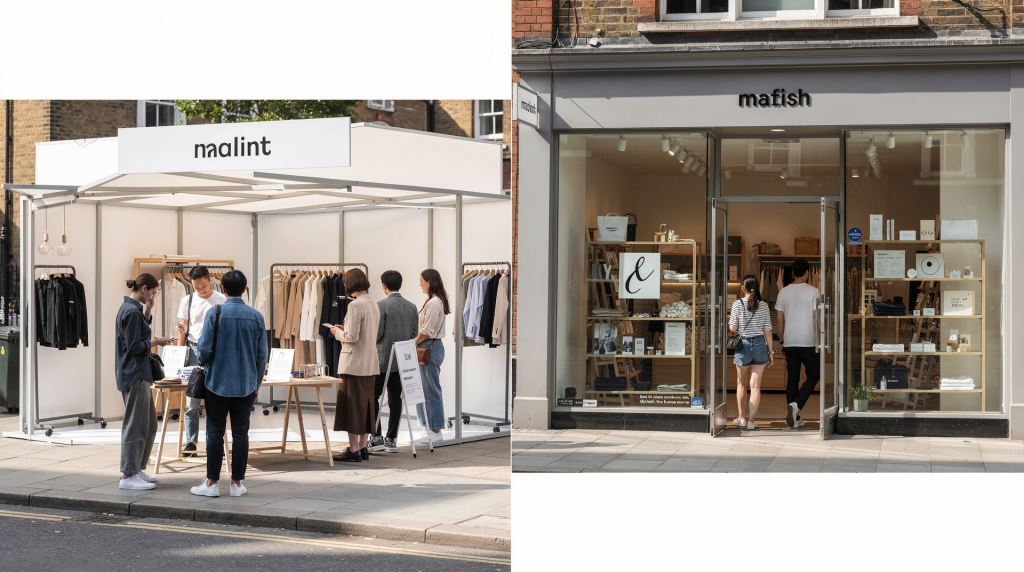
Every online brand eventually hits a point where shipping from a warehouse isn’t enough. Customers want to touch the product, see the brand in person, or buy immediately without waiting for delivery. That’s when the pop-up versus permanent debate begins. The right answer depends on a single, practical question: are you trying to test demand and gather real-world data, or are you ready to commit to a long-term physical retail channel? Having navigated this transition myself—from a spare-room fulfillment operation to leased warehouse space and eventually physical retail—I’ve learned that this choice ripples through your cash flow, inventory allocation, staffing model, and how quickly your brand can adapt when conditions change.
Introduction
Many online brands reach the same inflection point. The warehouse and 3PL relationships work, but customer behavior is shifting: people ask to see products in person, try sizes, or pick up orders same-day. At that stage, founders start comparing a pop-up shop with a permanent storefront. The decision isn’t just about rent per square foot. It reshapes your entire operating model—how you forecast inventory, how you hire and train staff, how you position the brand, and how fast you can exit if the location underperforms. Understanding the operational, financial, and strategic trade-offs is what separates a successful offline expansion from an expensive experiment.
What a Pop-Up Shop Actually Is
A pop-up shop is a short-term retail activation designed to test a market, launch products, create buzz, or capture seasonal demand. Terms can range from a single day to several months, and in some cases flexible short-term arrangements extend even longer through license agreements rather than traditional leases. For an e-commerce brand accustomed to shipping from a distribution center, a pop-up is the lowest-commitment way to put products in front of live customers and observe how they interact with the brand offline.
The main value is speed and flexibility. Pop-ups are often used to:
- test whether offline demand exists before signing a multi-year lease
- reach shoppers in high-traffic areas—malls, street retail, event venues—without building a full store from scratch
- introduce a new product line or seasonal collection with a concentrated marketing push
- gather face-to-face feedback on pricing, merchandising, and product assortment before scaling physical retail
From an operator’s perspective, a pop-up also forces you to solve real-world logistics quickly: how stock moves from your warehouse or 3PL to the shop floor, how you handle POS integration with your online inventory system, and how you capture customer data for post-visit retargeting. These are exactly the operational muscles you’ll need if you eventually go permanent.
What a Permanent Storefront Changes
A permanent storefront is a long-term commitment to a specific location, trade area, and customer base. It typically involves a multi-year lease—often three to five years with renewal options—a full build-out, compliance with local zoning and signage codes, and a clear reason for customers to visit repeatedly. This is not an experiment; it’s a retail channel that needs to generate consistent foot traffic and repeat purchases to justify the fixed cost base.
A permanent store makes sense when:
- the brand already has proof that local demand exists, backed by online order data or a successful pop-up
- the store can support repeat visits, not just one-time curiosity driven by novelty
- the location can drive enough organic traffic—or benefit from strong anchor tenants—to cover occupancy costs
- the brand is ready to treat retail as a core revenue channel, with dedicated inventory, staffing, and marketing budgets
In practice, a permanent store also becomes a hub for omnichannel operations: buy-online-pick-up-in-store, local returns, and even last-mile delivery from the store’s backroom. That operational versatility can improve margins and customer experience, but only if the lease terms and space layout support it.
Pop-Up Shop vs. Permanent Storefront: The Core Difference
| Factor | Pop-Up Shop | Permanent Storefront |
|---|---|---|
| Commitment | Short-term, flexible (days to several months) | Multi-year lease with significant financial commitment |
| Risk | Lower upfront and exit risk | Higher fixed-cost exposure and longer break-even |
| Purpose | Test, launch, promote, validate offline demand | Build a stable, recurring retail channel |
| Speed to open | Usually faster (weeks, not months) | Slower due to lease negotiation, permits, and build-out |
| Brand impact | Good for buzz, urgency, and experimentation | Better for permanence, local trust, and brand equity |
| Best for | Testing markets and products | Scaling a proven retail concept |
When a Pop-Up Shop Is the Better Choice
A pop-up is usually the smart first move if your brand is still answering questions like: Will people in this area buy in person? Which SKUs sell best when customers can touch them? Can we convert online traffic into walk-in traffic? What price points and merchandising setups work offline? These are not hypotheticals—they directly impact inventory allocation, staffing, and future lease decisions. A short-term activation lets you gather that data without the pressure of a long-term lease hanging over every decision.
Good use cases for a pop-up
- seasonal retail, such as holiday or summer collections, where demand is concentrated in a short window
- product launches that benefit from in-person demonstrations and immediate purchase
- new-city market tests before committing to a permanent location
- event-driven sales near festivals, fairs, or tourist zones with high transient traffic
- showroom-style selling for brands where tactile experience—fabric, fit, finish—drives conversion
Why pop-ups work well for online brands
They dramatically reduce the cost of learning. Instead of committing to years of rent and a full build-out, you can rent space for a shorter period—often through a license agreement that includes utilities and basic maintenance—and see how customers respond. Many operators also prefer pop-ups because they can be placed in high-traffic centers where shoppers are already in buying mode, leveraging existing footfall rather than trying to create it from scratch. For a brand that started online, this is the closest thing to A/B testing a physical location.
Common pop-up mistakes
- choosing a location for cheap rent instead of foot traffic—low cost means nothing if no one walks by
- bringing too much inventory and tying up cash that could be used for online ad spend or replenishment
- underestimating staffing needs on weekends and peak hours; a pop-up lives or dies by the quality of in-person selling
- treating the pop-up like a mini warehouse instead of a curated selling space—cluttered displays kill conversion
- failing to capture customer data (email, SMS opt-in) for future retargeting and post-pop-up follow-up
When a Permanent Storefront Is the Better Choice
A storefront becomes the stronger option when the pop-up has already proven demand, or when the brand is ready to build a real local market presence that supports omnichannel operations. This is the stage where you stop asking “if” and start asking “where” and “how.” The financial commitment is higher, but so is the potential for consistent revenue and brand reinforcement.
Signs you may be ready
- customers are repeatedly asking for a permanent location, indicating unmet local demand
- the pop-up delivered strong conversion rates and consistent traffic, not just a one-week spike
- the brand needs a showroom, service point, or brand destination that reinforces credibility
- the store will support omnichannel use, such as buy-online-pick-up-in-store, local returns, or same-day delivery from store stock
Why permanent stores can be worth it
A permanent store creates consistency. Customers know where to find you, staff get better at selling over time, and the location can become part of the brand identity. For the right brand, that visibility strengthens trust and improves customer lifetime value—especially when physical shopping supports the online channel rather than competing with it. I’ve seen brands use their store as a content studio, a community event space, and a returns drop-off point, all of which add value beyond the direct sales per square foot.
The Financial Trade-Off
The biggest difference isn’t just the rent check. It’s the entire cost structure and the flexibility to walk away if things don’t work. When you’re used to variable costs in e-commerce—shipping, packaging, digital ads—the fixed-cost world of commercial leases can be a shock. Understanding the full occupancy cost is critical.
Pop-up cost profile
- shorter lease or license period, often with a fixed weekly or monthly rate that may include utilities and basic maintenance
- lower build-out expectations; many pop-ups use modular fixtures and portable branding
- less long-term exposure if the location underperforms—you can simply not renew
- easier to exit if demand is weak, with minimal lease break penalties
Permanent store cost profile
- longer commitment to base rent plus additional costs: property taxes, insurance, common area maintenance (CAM)—often called a triple net lease
- higher build-out and compliance costs, including permits, signage, ADA compliance, and possibly a landlord-required fit-out standard
- more planning for staffing, inventory carrying costs, insurance, and ongoing maintenance
- greater upside if the location performs well over time, but also greater downside if traffic patterns shift
A useful rule: if you’re still unsure about demand, the flexibility of a pop-up is usually worth more than the prestige of a permanent store. The option to walk away after three months is a financial advantage that shouldn’t be underestimated.
How to Decide: A Practical Framework
Use this simple filter based on your current stage and data maturity. The key is to be honest about whether you have proof of demand or just a hunch.
Choose a pop-up if:
- you want to test a new market with minimal upfront cost
- your offline strategy is still experimental and you need real-world feedback
- you are launching a product or collection and need a physical stage for the launch
- you need a low-risk way to generate brand awareness and collect customer data
- you do not yet know the right neighborhood or customer profile for a permanent location
Choose a permanent storefront if:
- you already have proof of local demand—strong online sales from that area, a successful pop-up, or waitlists
- you need a stable retail base for recurring sales and customer retention
- the store will also support returns, service, pickup, or community-building events
- you can afford the fixed costs without depending on perfect monthly performance; you have a cash buffer for slow seasons
Step-by-Step: How to Evaluate the Right Option
1. Define the goal
Be specific. Are you trying to sell excess inventory, collect leads, test a neighborhood’s demographics, or build a flagship presence that embodies the brand? The goal dictates the format, location, and duration.
2. Estimate demand
Review online customer geography, repeat purchase patterns, social media engagement by city, and shipping data. If a particular metro area already accounts for 10-15% of your revenue, it’s a strong candidate for an offline test. Use that data to choose a neighborhood, not just a city.
3. Match format to objective
A short-term activation is better for testing and learning. A long-term store is better for retention and brand building. Don’t sign a five-year lease to answer a question a two-month pop-up could resolve.
4. Check the economics
Compare total occupancy cost (base rent + CAM + taxes + insurance + utilities), fit-out cost, staffing, inventory requirements, expected sales volume, and exit risk. For a pop-up, also factor in the cost of temporary fixtures and any short-term staffing agency fees. For a permanent store, model the break-even point and understand how seasonal fluctuations affect cash flow.
5. Review operational fit
Ask whether the space can handle merchandising, storage, point-of-sale setup, receiving stock, customer service, and returns handling. If you’re running a pop-up, plan how you’ll replenish inventory from your warehouse or 3PL—daily restocks may be necessary. For a permanent store, consider whether you need a small backroom stock area or if you can rely on frequent deliveries from a nearby micro-fulfillment node.
6. Plan for data capture
No matter which option you choose, make sure the space helps you collect useful customer data. Integrate your POS with your CRM, offer WiFi capture, and train staff to ask for email or SMS opt-ins. The offline visit should feed your online retargeting engine, not exist in isolation.
What Online Brands Often Overlook
Inventory planning
Physical retail usually requires more disciplined inventory allocation than e-commerce. If a product sells well in-store, you need a plan to replenish it quickly without starving your online channel. If it sells slowly, you need a markdown strategy. I’ve seen brands make the mistake of pulling inventory from the same pool as online orders, leading to stockouts on the website when the store has a good weekend. Ring-fence a percentage of stock specifically for the physical location and set reorder points based on sell-through rate.
Staffing
The best location in the world won’t fix poor in-store execution. Pop-ups often fail because they are under-staffed during peak traffic or staffed by people who don’t know how to sell the product. Invest in training that covers product knowledge, brand story, and how to handle objections. For a permanent store, factor in management overhead and the cost of employee turnover.
Brand consistency
A physical space changes how customers experience the brand. Everything matters: signage, packaging, lighting, music, and how fast the staff can answer product questions. The store should feel like a natural extension of your online presence, not a disconnected afterthought. If your website is minimalist and high-end, a cluttered, fluorescent-lit pop-up will confuse customers.
Exit terms
Short-term space is valuable precisely because it can end quickly if the concept doesn’t work. Before signing a pop-up license, clarify notice periods and any holdover penalties. For permanent stores, pay close attention to lease structure: break options, assignment clauses, and subletting rights. The ability to exit or transfer a lease can save you from a cash-draining location if circumstances change.
A Simple Decision Table
| Your Situation | Better Fit |
|---|---|
| Testing a first physical location | Pop-up shop |
| Launching a new product line | Pop-up shop |
| Expanding into a proven city | Permanent storefront |
| Need for long-term customer access | Permanent storefront |
| Brand still validating offline demand | Pop-up shop |
| Strong repeat local demand already exists | Permanent storefront |
Checklist Before You Sign Anything
- define the exact business goal and how you’ll measure success
- confirm your target customer is actually in that area—use mobile location data or customer surveys
- calculate total occupancy cost, not just base rent: include CAM, taxes, insurance, utilities, and any percentage rent clauses
- know how much inventory the space needs and where it will be stored
- plan staffing for peak and slow periods; don’t assume one person can handle everything
- decide how customers will move from offline to online—QR codes, email capture, loyalty program sign-ups
- check whether the layout supports your merchandising style and customer flow
- review insurance, signage restrictions, operating hours, and any exclusive-use clauses that might limit your product categories
- prepare an exit plan before opening: know the notice period and any costs to terminate early
Bottom Line
A pop-up shop is the right first move when your online brand needs proof, speed, and flexibility. It lets you test demand, refine your in-person selling approach, and gather data without the weight of a long-term lease. A permanent storefront is the right move when the market has already validated your concept and the store can support long-term growth, omnichannel operations, and brand equity. In practice, many strong brands use both: pop-up first to learn, permanent later to scale. The key is to let real customer behavior—not just ambition—dictate the timing.
FAQ
Is a pop-up shop cheaper than a permanent storefront?
Usually yes, because the commitment is shorter and the build-out is often lighter. However, total cost still depends on location, staffing, inventory, and activation length. A high-traffic pop-up in a prime mall can cost more per day than a modest permanent store in a secondary location. Always compare total occupancy cost and the value of flexibility.
How long does a pop-up shop usually last?
Pop-ups can last from a single day to several months. Some specialty retail arrangements extend up to a year through renewable license agreements. The duration should match your testing or promotional goal—long enough to gather meaningful data, short enough to limit risk.
Can a pop-up shop lead to a permanent store?
Yes. That is one of the most common strategies: test the market first with a pop-up, collect sales and traffic data, then convert successful locations into long-term stores. Many landlords are open to this path because it reduces their risk too—they’d rather see a proven concept sign a longer lease.
What type of brand benefits most from a pop-up?
Brands that rely on touch, fit, demonstration, discovery, or seasonality often get strong value from pop-ups. Apparel, accessories, beauty, home goods, and specialty food are classic examples. If the online purchase barrier is “I need to see it in person,” a pop-up can directly address that.
When should an online brand skip the pop-up and go straight to a storefront?
When demand is already proven—through consistent online orders from a concentrated area, a waitlist, or overwhelming social media engagement—and the location is clearly strategic. The business must also be able to absorb the long-term cost of a permanent lease without relying on perfect monthly sales. If you have the data and the financial cushion, a direct move to a storefront can capture market share faster.