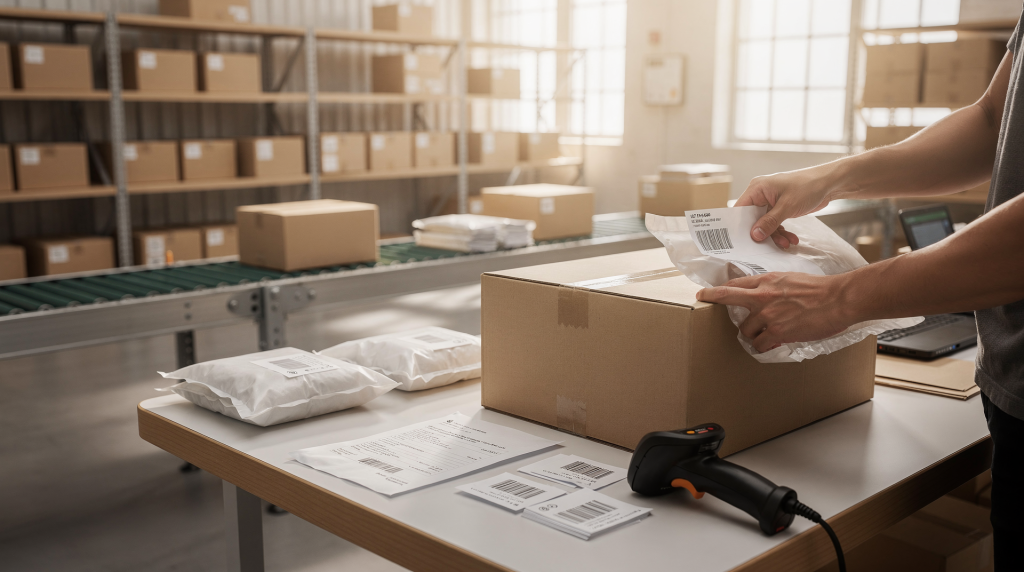
E-commerce fulfillment is the operational engine that turns an online order into a delivered package. It covers every physical step: receiving inventory, storing it, picking items, packing boxes, shipping, and handling returns. For growing brands, fulfillment isn’t just a back-office task — it’s a lever that directly shapes delivery speed, customer satisfaction, and cash flow. And from a real estate perspective, it’s the function that dictates what kind of space you need, whether that’s a spare room, a leased warehouse, or a third-party logistics facility in an industrial park.
E-Commerce Fulfillment, in Plain English
Think of fulfillment as the physical half of every online sale. A customer clicks “buy,” and the fulfillment system takes over: the order is routed, inventory is reserved, items are pulled from storage, packed into a shipment, labeled, handed to a carrier, and tracked until delivery. It’s the bridge between a digital storefront and a physical product arriving at a doorstep.
A quick way to separate the terms that often get mixed up:
- Fulfillment = the complete process of getting an order to a customer.
- 3PL = a third-party logistics provider that handles some or all of that process for you, typically using their own warehouse space.
- Fulfillment center = the physical facility where those operations happen — a specialized type of commercial property designed for rapid order processing, not just static storage.
When I ran my online electronics store, I learned this distinction the hard way. Early on, fulfillment meant stacking boxes in the living room. But as order volume grew, the space itself became a bottleneck. Understanding the difference between a generic warehouse and a purpose-built fulfillment center helped me choose the right property later — one with loading docks, high ceilings, and a layout that supported pick-and-pack workflows, not just pallet storage.
How E-Commerce Fulfillment Works Step by Step
1. Inventory arrives at the warehouse
Products are shipped from the brand, manufacturer, or port to the warehouse or 3PL facility. The inventory is checked in, counted, and entered into the warehouse management system so the business knows exactly what’s available to sell. From a real estate standpoint, this step demands adequate receiving space — dock doors, staging areas, and enough clearance for pallet jacks or forklifts. I’ve seen brands lease a cheap unit only to discover the loading dock can’t handle a standard 53-foot trailer, which turns every inbound shipment into a logistical headache.
2. Inventory is stored in assigned locations
Each SKU is placed in a specific bin, shelf, rack, or pallet location. Good storage setup reduces picking errors and makes it easier to replenish fast-moving products. The physical layout of the warehouse matters enormously here: ceiling height determines how high you can rack, column spacing affects aisle width, and floor load capacity limits what you can store. In one of my early leases, I underestimated the importance of clear ceiling height and ended up with only two levels of racking instead of four — effectively paying for vertical space I couldn’t use.
3. Orders flow into the fulfillment system
When a customer places an order online, the ecommerce platform sends the order details to the fulfillment system. That system decides where the order should be picked from and which shipping method makes the most sense based on speed, price, package size, and service level goals. The location of the warehouse directly influences these decisions: a facility near a major carrier hub can extend same-day shipping cutoffs, while a remote location adds transit time and cost. This is why last-mile delivery considerations are now baked into site selection for fulfillment centers.
4. Items are picked
Warehouse staff or automation retrieves the ordered items from storage. In simple terms, this is the “go find the product” step. Accuracy here is critical because one wrong pick creates a customer service problem later. The efficiency of picking depends heavily on warehouse design — logical slotting, clear signage, and travel distance between high-velocity SKUs. When evaluating a potential lease, I now walk the floor imagining pick paths, not just counting square meters.
5. Orders are packed
Picked items are placed into the right box, mailer, or custom package. Packing also includes inserts, void fill, labels, invoices if needed, and any special handling for fragile or regulated products. A well-designed packing station requires enough bench space, easy access to supplies, and proximity to the shipping area. In tight quarters, packing becomes a disorganized mess that slows down the entire operation.
6. The shipment is labeled and handed off
A shipping label is created, the parcel is sorted, and the carrier scans it into their network. That scan usually triggers tracking updates for the merchant and the customer. The handoff point — whether it’s a carrier pickup at the dock or a drop-off at a hub — depends on the property’s location and accessibility. Industrial parks with dedicated truck courts and flexible pickup schedules make this step seamless; a cramped downtown storefront does not.
7. Delivery and returns
The order moves through the carrier network until it reaches the customer. If the item comes back, returns processing checks the item, restocks it if possible, and updates inventory records. Returns require their own dedicated space within the facility — a receiving area for inspection, a quarantine zone for damaged goods, and a restocking path back into active inventory. Without that physical footprint, returns quickly clog the workflow.
The Main Fulfillment Models
Different brands handle fulfillment in different ways. The right model depends on order volume, margin, inventory complexity, and how much operational control the business wants. But there’s also a real estate dimension: each model carries different space requirements, lease commitments, and location trade-offs.
| Model | How it works | Best for | Main drawback |
|---|---|---|---|
| In-house fulfillment | The brand leases or owns its own warehouse space, stores inventory, and ships orders itself. | Small brands, startups, or operations needing tight control over quality and branding. | Labor-heavy, hard to scale, and ties up capital in a long-term lease with costs like triple net charges, maintenance, and utilities. |
| 3PL fulfillment | A third party uses its own warehouse network to store and ship inventory on the brand’s behalf. | Growing brands that want to outsource logistics without signing a direct lease. | Less direct control over daily operations; the brand depends on the 3PL’s choice of facility location and layout. |
| Marketplace fulfillment | A marketplace program (like FBA) handles storage and shipping for orders placed on that platform. | Sellers focused on one platform and willing to follow its rules. | Platform dependency and restrictions on inventory placement, which can limit multi-channel flexibility. |
When a 3PL Makes Sense
A 3PL becomes valuable when fulfillment starts consuming too much time or space. Common signs include:
- Inventory is taking over the office, garage, or apartment — a clear signal that residential or small-office space is no longer viable.
- Orders are growing faster than the team can pack them, and hiring more people in a cramped space creates safety and efficiency issues.
- Shipping cutoffs are hard to meet consistently because the current location is too far from carrier hubs.
- Peak seasons create chaos that a flexible 3PL can absorb without the brand having to lease extra seasonal space.
- The business needs multiple warehouse locations or faster delivery zones, which would require a portfolio of leases the brand may not be ready to manage.
A good 3PL does more than store boxes. It can help route orders, reduce shipping times by placing inventory closer to customers, and handle returns in a more systematic way. From a real estate perspective, using a 3PL means you avoid signing a 3–5 year lease with its attendant risks: base rent, common area maintenance, property taxes, and insurance (the triple net burden). Instead, you pay variable fees tied to actual usage — a model that often suits brands with fluctuating order volumes.
What Happens Inside a 3PL Operation
A 3PL typically manages some combination of:
- Receiving inventory
- Warehousing and storage
- Order processing
- Picking and packing
- Shipping
- Tracking
- Returns handling
For many brands, the biggest benefit is operational focus. Instead of spending the day printing labels and counting cartons, the team can focus on product development, marketing, and sales. But it’s worth noting that the 3PL’s choice of facility matters to you as much as it does to them. A 3PL operating out of a modern industrial park near a major interstate and an airport can offer faster ground and air shipping than one in a remote low-rent district. When evaluating a 3PL, I always ask to see the facility or at least understand its location and layout — because their real estate decisions directly affect your delivery promises.
How to Choose the Right Fulfillment Setup
The best model is the one that matches your order pattern, not the one that looks cheapest on paper. And it must align with your appetite for real estate commitments.
Use this checklist
- Monthly order volume is stable enough to forecast — so you can right-size space or negotiate flexible 3PL terms.
- SKU count is manageable for your team or provider within the available storage footprint.
- Product size and weight do not create extreme shipping costs that eat into the margin you’d otherwise spend on rent or fees.
- You understand your return rate, which affects how much processing space you need.
- You know which delivery promises matter to your customers — and whether your location or your 3PL’s network can meet them.
- You have enough margin to cover storage, pick fees, packing, and freight — and, if you go in-house, the full cost of occupancy including triple net charges.
- You’ve considered scalability: can the space or 3PL relationship grow with you, or will you need to move again in 12 months?
Ask these questions before outsourcing
- Where will inventory be stored? (Specific facility location, proximity to carrier hubs, and accessibility for inbound freight.)
- How fast are orders processed?
- What are the cut-off times for same-day shipping?
- How are inventory discrepancies handled?
- What systems integrate with your ecommerce platform?
- How are returns inspected and restocked?
- What fees apply during peak season?
- Is the 3PL’s lease on the facility long-term, and what happens if they need to relocate?
Common Fulfillment Mistakes
1. Underestimating storage needs
Fast-growing brands often run out of space before they run out of demand. That leads to cluttered stock, poor inventory control, and slower order handling. In real estate terms, it means you signed a lease for 2,000 square feet when you really needed 4,000 — and breaking a lease or expanding mid-term is expensive and disruptive.
2. Ignoring SKU-level complexity
A business with 20 bulky SKUs is much harder to fulfill than a business with 200 small, similar items. Bulky products demand more cubic footage, different racking, and often higher shipping costs. The warehouse that looked spacious on paper can feel cramped once those large items are slotted.
3. Choosing a provider only by headline price
Low per-order rates can hide storage fees, inbound fees, packaging charges, minimums, or expensive return processing. The same goes for leasing: a low base rent per square foot may be offset by high triple net charges, making the total occupancy cost far higher than expected.
4. Weak inventory data
If the system says stock exists but the shelf is empty, the entire operation breaks down. This is often a symptom of poor warehouse layout or insufficient space for proper organization — problems that start with the physical environment.
5. Treating returns as an afterthought
Returns are not just a customer service issue. They affect available inventory, cash flow, and warehouse labor. A facility without a dedicated returns processing zone will quickly see reverse logistics gum up the forward-picking operation. I’ve walked into warehouses where returns piled up in aisles because nobody planned for the space.
Practical Example
Imagine a skincare brand that sells 2,000 orders per month. They started in a home office, but as inventory grew, they leased a 1,500-square-foot industrial unit in a business park near a major carrier hub. The space had a small dock, 16-foot clear ceilings, and enough room for racking and a packing line.
Here’s how fulfillment flows in that space:
- Inventory arrives in pallets from the manufacturer and is checked in at the dock.
- The 3PL (or in-house team) stores cleansers, serums, and moisturizers in labeled bin locations on pallet racks.
- When an order comes in, the system reserves one of each item and directs a picker to the right locations.
- A picker gathers the products, a packer places them in a mailer with branded inserts, and the carrier picks up the parcel from the dock the same day.
- If a customer returns a damaged item, the warehouse inspects it in a designated returns area and either restocks or writes it off.
That is fulfillment in practice: storage, movement, accuracy, and speed working together within four walls that were chosen specifically for this workflow. The lease is a 3-year term with a fair triple net structure, and the location keeps ground shipping times under two days for 80% of their customers.
What Good Fulfillment Looks Like
Strong fulfillment usually has these traits:
- Orders ship on time, with cutoffs that reflect the facility’s location and carrier schedules.
- Inventory counts match actual stock, supported by a layout that makes cycle counting easy.
- Tracking updates appear quickly because the handoff to the carrier is seamless.
- Damage and mis-picks are rare, thanks to well-designed pick paths and packing stations.
- Returns are processed without long delays in a dedicated area that doesn’t interfere with outbound orders.
- Shipping costs stay predictable enough to protect margin, and occupancy costs (whether lease or 3PL fees) are transparent and manageable.
If those basics are not happening, the problem is usually not just “shipping.” It is often a mix of inventory planning, warehouse layout, process design, and system integration — and sometimes the root cause is a facility that simply doesn’t fit the operation anymore.
Key Terms to Know
- SKU: A unique stock keeping unit for one product variant.
- WMS: Warehouse management system used to track inventory and operations.
- Pick and pack: Retrieving products and preparing them for shipment.
- Returns processing: Inspecting returned items and deciding whether they can be restocked.
- SLA: Service level agreement that defines performance expectations.
- Triple Net Lease (NNN): A lease structure where the tenant pays base rent plus property taxes, insurance, and maintenance — common in industrial and retail properties.
- Last-mile delivery: The final leg of shipping from a distribution hub to the customer’s address, heavily influenced by warehouse location.
The Bottom Line
E-commerce fulfillment is the operational engine behind online sales. It starts when inventory enters the warehouse and ends when the customer receives the order or sends it back. For small brands, it may begin in-house with a few shelves in a spare room. For growing brands, it often shifts to a 3PL that can store inventory, process orders, ship faster, and manage returns at scale — without the brand having to sign a long-term lease. Whichever path you choose, the physical space where fulfillment happens is not an afterthought. It’s a strategic asset that affects speed, cost, and customer experience. Understanding the real estate behind fulfillment — from racking height to dock doors to lease terms — is what separates brands that scale smoothly from those that stumble over their own inventory.
FAQ
What does e-commerce fulfillment mean?
It means storing inventory, processing online orders, picking and packing products, shipping them to customers, and handling returns when needed. The physical location where this happens — whether a home, a leased warehouse, or a 3PL facility — determines how efficiently it can be done.
Is a 3PL the same as fulfillment?
No. Fulfillment is the process. A 3PL is the outside company that performs some or all of that process for you, typically using its own network of warehouse properties. Choosing a 3PL means you’re relying on their real estate decisions, so it’s important to understand where their facilities are located and how they’re configured.
When should a brand outsource fulfillment?
Outsourcing makes sense when order volume, storage needs, or delivery expectations become too difficult to manage in-house — and when the brand wants to avoid the capital commitment and long-term lease obligations of its own warehouse space.
What is the difference between a warehouse and a fulfillment center?
A warehouse mainly stores goods, often in bulk, with minimal processing. A fulfillment center is designed to receive inventory, pick orders, pack them, and ship them out rapidly. From a real estate perspective, fulfillment centers require more dock doors, higher power capacity for automation, and layouts optimized for flow rather than dense storage.
Why does fulfillment affect customer experience so much?
Because speed, accuracy, packaging, and tracking all shape how customers feel after they place an order. The location of the fulfillment facility directly impacts delivery speed, and a well-organized space reduces errors and damage — both of which influence repeat purchases and brand reputation.